Most AI systems today are built to predict.
What will happen next.
What is likely.
What pattern exists.
And in controlled environments, that works.
But in real systems, prediction is only the beginning.
Because a prediction has no value unless it leads to a decision.
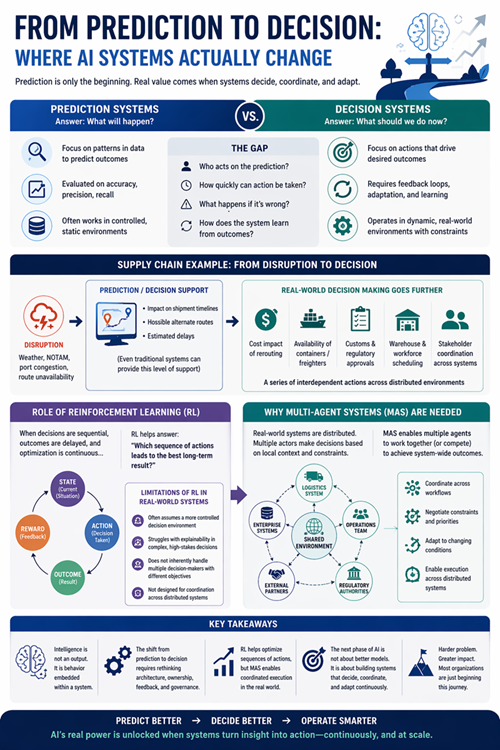
The shift becomes clearer when viewed through a system lens:
In early-stage implementations, this gap is often overlooked.
Models are evaluated on accuracy and performance metrics, and many perform well in isolation.
But once deployed, a different set of questions begins to matter:
Who acts on the prediction?
How quickly can action be taken?
What happens if the prediction is wrong?
How does the system learn from outcomes?
This is where many AI initiatives begin to struggle.
Not because the models are weak.
But because the system is not designed to translate prediction into coordinated action.
To understand this better, consider a supply chain scenario.
A disruption occurs—caused by weather, a NOTAM restriction, port congestion, or route unavailability.
A typical AI system can predict:
• impact on shipment timelines
• potential alternate routes
• estimated delays
In many cases, even rule-based or traditional systems can provide this level of decision support.
But real-world decision-making goes much further.
It involves:
• evaluating cost implications of rerouting
• checking availability of containers, carriers, or freighters
• securing customs and regulatory approvals
• aligning warehouse capacity and workforce schedules
• coordinating across multiple stakeholders and systems
This is not a single decision.
It is a sequence of interdependent actions, executed across distributed environments.
And this is where most systems begin to break down.
Not because the prediction is wrong.
But because the system is not designed to absorb, coordinate, and act on that intelligence.
This is the point where the shift begins:
From prediction systems to decision systems.
A decision system does not just answer “what will happen?”
It continuously evaluates:
What should we do now?
What is the impact of this action on future outcomes?
How do we adapt as conditions change?
This introduces fundamentally different requirements.
Decisions become stateful.
Actions influence future states.
Feedback loops become essential.
Trade-offs must be managed continuously.
This is where reinforcement learning becomes relevant.
In environments where decisions are sequential, outcomes are delayed, and optimization is continuous, systems must learn not just outcomes—but behavior.
Reinforcement learning helps answer:
Which sequence of actions leads to the best long-term result?
However, real-world systems rarely operate in a single, controlled decision environment.
They are inherently distributed.
Decisions are made across:
• logistics platforms
• enterprise systems
• operational teams
• regulatory authorities
• external partners
Each with its own constraints, incentives, and timelines.
This is where reinforcement learning alone is not sufficient.
The challenge is no longer just learning an optimal policy.
It is coordinating multiple decision-makers operating within the same system.
This is where multi-agent systems become relevant.
Multiple agents interact within a shared environment, each making decisions based on local context, while collectively shaping system-wide outcomes.
They:
• coordinate across workflows
• negotiate constraints and priorities
• adapt to changing conditions
• enable execution across distributed systems
In complex environments like supply chains, financial systems, or large-scale enterprise operations, this reflects reality far more accurately than centralized decision models.
In earlier phases of AI adoption, prediction was often sufficient because systems were smaller in scope and heavily dependent on human intervention.
But as organizations move toward real-time decisioning, automation, and large-scale optimization, the limitations of prediction-centric approaches become visible.
The transition from prediction to decision is not just a technical evolution.
It requires rethinking system architecture, decision ownership, feedback mechanisms, and governance models.
More importantly, it requires a shift in mindset.
Intelligence is not an output produced by a model.
It is behavior embedded within a system.
The next phase of AI is not about building better models.
It is about building systems that can decide, coordinate, and adapt continuously—at scale and under real-world constraints.
That is a significantly harder problem.
And most organizations are only beginning to engage with it.